
Strategic Alliance Game
Test your strategy while sharing a service with a competitor
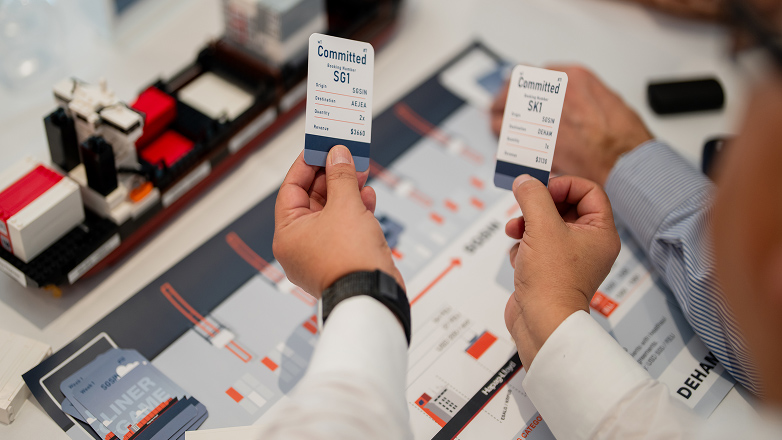
In a liner shipping alliance, carriers share vessel capacity and coordinate the service while still competing for customers and profit. Each line keeps its own commercial strategy and customer relationships.
Teams use physical LEGO® vessels and containers alongside a digital dashboard that tracks utilisation, schedule reliability, customer service quality and profit as the rounds progress.
The Strategic Alliance Game recreates that problem for experienced liner shipping teams. Two partner lines decide which KPIs to prioritise, then make booking, slot-trading and stowage decisions across the shared service.
Balance bookings against capacity across eight ports
In the Strategic Alliance Game, two partners operate an Asia–Middle East–Europe service with eight 54 FEU vessels and eight ports. They share vessel capacity through a vessel sharing agreement and can trade slots when demand no longer matches the capacity allocated to each line.
Accept more cargo at one port, and there may be less capacity available later in the service, with knock-on effects for reliability and customer commitments elsewhere in the network.
Partner A
Own booking uptake
Own commercial priorities
Can trade slots with Partner B
Shared service
8 vessels · 8 ports
Shared vessel capacity
Partner B
Own booking uptake
Own commercial priorities
Can trade slots with Partner A
Stress test bookings, slot trading and stowage
Participants rotate through three roles, moving from strategic priorities into commercial and operational decisions, then performance review.
Strategise and coordinate
Teams use physical LEGO® vessels and containers alongside a digital dashboard that tracks utilisation, schedule reliability, customer service quality and profit as the rounds progress.
Uptake and capacity
Optimise booking uptake against available capacity and trade slots as market conditions change.
Stowage and performance
Execute the stowage plan, compare performance with the prioritised KPIs and adjust the next round.
When demand shifts, revisit booking uptake and slot allocation
Conditions change
Demand or prices shift
Strike or weather disruption
Capacity no longer matches demand
Teams decide
Revise booking uptake or trade slots
Adjust the next stowage and service decisions
Terminal tractor fuel costs
Then review
Utilisation
Schedule reliability
Customer service and profit
When KPIs compete, choose what you must protect
Participants weigh revenue, utilisation, customer service, schedule reliability and cost-efficient operations against the priorities they set for the line. The workshop makes those trade-offs concrete through booking, capacity, stowage and alliance decisions under changing market conditions.
As later rounds introduce operational and commercial disruption, teams have to revisit those trade-offs under changing conditions rather than discuss them only in principle.
Built for experienced teams to sharpen strategy execution
The Strategic Alliance Game is designed for experienced maritime professionals and teams that already understand the commercial and operational fundamentals of liner shipping.
Instead of revisiting those fundamentals, the workshop moves into competitive strategy, vessel sharing agreements, cross-company coordination and execution under changing market conditions.

Tested at executive scale
with Hapag-Lloyd
Four breakout rooms each ran two parallel alliance simulations. In this custom version, four competing container shipping lines operated a shared Asia–Europe service, with each participant responsible for one port and its decisions on bookings, capacity allocation, vessel utilisation, schedule reliability and customer service.
A custom-developed digital platform recorded those decisions and returned live performance feedback throughout the exercise. The workshop concluded with an executive debrief aligned with Hapag-Lloyd’s priorities across quality, commercial performance, operational excellence, and customer value.