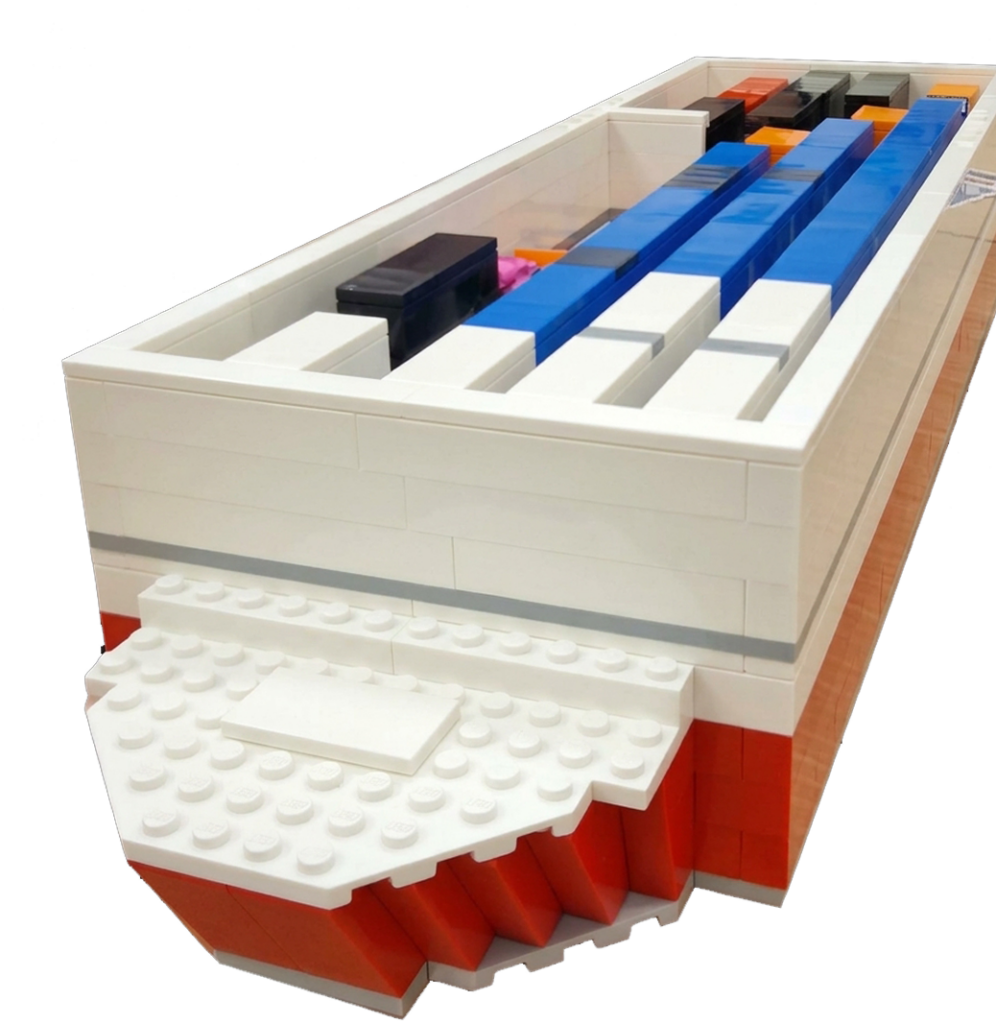
In the RoRo Shipping Game, participants run a simulated short-sea ferry service together. They decide which bookings to accept, plan the stow and work the vessel in port, using physical LEGO® ship and cargo models alongside a digital workflow and scoreboard.
Across each round, the workshop shows how those decisions play out in port time, revenue, fuel use and emissions.
RoRo means managing late arrivals, lane meters, vessel stability and terminal operations
RoRo cargo makes capacity a physical planning problem. Teams work in lane metres and vessel weight, while the cargo mix determines how the available deck space can actually be used. Reefers need powered positions, hazardous cargo follow placement rules, and heavy, long or special units can narrow the remaining options for stowage.
Once you take the booking, the vessel has to carry it
Booking uptake
Review incoming bookings and decide what cargo to accept, balancing customer commitments against the space available on the vessel. Late arrivals and no-shows can leave the team with a different cargo mix from the one originally planned.
Capacity Stowage
Turn the cargo that arrives into a workable stow within the available lane metres and vessel weight. Participants see how choices made during booking translate into finite deck space and placement decisions.
Cargo & Vessel Operations
Allocate terminal tractors and complete the cargo operation before sailing. Participants see how decisions made in port affect turnaround time, fuel use and operating cost.
Face new challenges as the game progresses
Once the team understands the basic principles of a RoRo service, later rounds introduce more complex challenges and disruptions faced by the RoRo industry. A workshop can run across as many as five rounds.
Round 1 Base service
Later rounds can introduce
01
Late arrivals & no-shows
02
Dual cycling
03
Heavy weather
04
Digitalisation
05
Electrification
Instantly see the business impact
of your decisions
Utilisation
Vessel capacity
Loaded and rolled cargo
Port stay
Terminal tractor movements
Profitability
Cargo revenue
Vessel fuel costs
Terminal tractor fuel costs
Rolling penalties
Sustainability
Fuel consumption
GHG / CO₂ emissions
Your choices lead to gains or trade-offs across utilization, profitability, and sustainability.
A workshop tailored to your team's experience and learning objectives
The workshop can be adjusted for people who are new to RoRo shipping or already work in the sector. Newer participants learn terminology, cargo flows and the sequence behind a ferry departure by running the service themselves, while experienced groups can take on harder scenarios and decisions outside their usual function.
Ports, logistics companies and relevant technology providers can also use the workshop for team development and broader industry learning.
The RoRo Story
The RoRo Shipping Game grew out of the ECOPRODIGI and RoRoGreen research projects carried out from 2018 to 2022 with Aalborg University and the University of Southern Denmark. Niels Gorm Maly Rytter and Nicolai Hinge continued developing the game from 2023 to 2026 through demonstrations, testing and collaboration with industry partners and authorities.
In February 2026, they delivered a complete game set and train-the-trainer workshop to Klaipėda University’s STEAM Centre in Lithuania, where the game is now used to introduce students and young professionals to RoRo shipping.
Run a half- or full-day RoRo Shipping Game for 4–20 participants, adapted to your team’s experience and the purpose of the session. Depending on the setup, participants can operate one or two competing short-sea ferry services with a RoRo shipping expert facilitating the workshop.
Open Workshops
Join an upcoming RoRo Shipping Game with participants from across the industry. If no RoRo dates are currently available, register your interest for a future session.